
How to Identify Your Tyre Size: A Simple Guide for UK Drivers
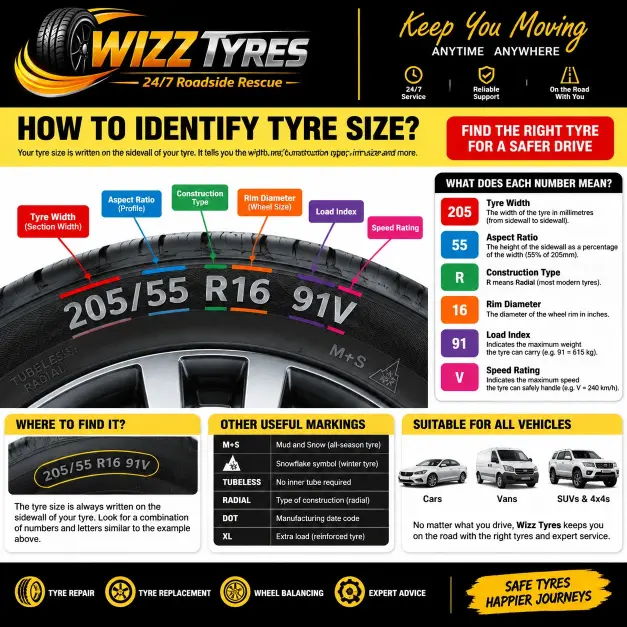
Buying a replacement tyre sounds straightforward until someone asks you a simple question: “What size tyre do you need?” If you have never read the markings on a tyre before, a code such as 205/55 R16 91V can look confusing. In reality, that short combination of numbers and letters contains several important pieces of information about the tyre, including its width, profile, wheel diameter, load capacity and speed capability. The good news is that you normally do not need to measure the tyre yourself. The information is already printed on the tyre sidewall. In this guide, we explain how to identify your tyre size, what each part of the marking means, where else you can check your vehicle’s recommended specification, and what to consider before ordering a replacement. Whether you are replacing a worn tyre, dealing with a puncture, preparing for a motorway journey or simply trying to understand your car better, knowing how to read these markings can save time and help you provide the right information when speaking with a tyre professional. Where Can I Find My Tyre Size? The easiest place to start is the sidewall of the tyre. Look around the outer side of the tyre for a sequence containing numbers and letters. A common example is: 205/55 R16 91V The exact combination will vary according to your vehicle and the tyre fitted. TyreSafe explains that the sidewall carries several pieces of information, including the tyre dimensions, service description, manufacturer details and other identification markings. What should you look for? You are looking for the part that resembles: 205/55 R16 – You may then see another number and letter immediately afterwards: 91V Together, these markings tell you considerably more than the physical width of the tyre. What if I cannot see the complete marking? Do not assume that the tyre has no size information. Part of the marking may simply be hidden from your view because of the position of the wheel. If it is safe to do so, inspect the accessible section of the sidewall carefully. However, do not put yourself at risk to read a tyre, particularly if your vehicle is stopped on a busy road, hard shoulder or motorway. If you are dealing with a roadside problem, safety should come before identifying a number printed on the tyre. How to Read the Numbers on Your Tyre Let’s use this example: 205/55 R16 91V Each part has a specific purpose. Marking What it tells you 205 Nominal tyre width in millimetres 55 Aspect ratio R Radial construction 16 Rim diameter in inches 91 Load index V Speed symbol The first four characters describe the physical tyre dimensions and construction. The final number and letter describe its load and speed capability. Let’s look at each one separately. What Does 205 Mean on a Tyre? The first number represents the tyre’s nominal section width, expressed in millimetres. So, in: 205/55 R16 the 205 relates to a nominal width of 205 mm. It is important not to interpret this as a measurement that you should take with a tape measure and use to choose another tyre. Tyre dimensions are specified according to established tyre standards and manufacturer specifications. The number is there to identify the tyre specification. Why does tyre width matter? Width affects how the tyre interfaces with the road and forms part of the vehicle’s approved wheel-and-tyre combination. Changing from the manufacturer’s specified size can affect factors such as: For that reason, choosing a replacement should involve more than simply finding something that appears physically similar. What Does 55 Mean on a Tyre? The second number is the aspect ratio. In: 205/55 R16 the number 55 means that the sidewall height is approximately 55% of the nominal tyre width. Using the example: 205 × 55% = approximately 112.75 mm That calculation helps illustrate the relationship between width and sidewall height. It does not mean that every physical measurement of the tyre will correspond exactly to that figure. Why is aspect ratio important? A change in profile can alter the overall characteristics of the wheel and tyre assembly. For example, moving to a lower-profile tyre may change the vehicle’s appearance and handling response, but it is not automatically an appropriate upgrade. If you are considering a different size, check the vehicle manufacturer’s approved specifications or ask a qualified tyre professional rather than making the decision based solely on appearance. What Does R Mean on a Tyre? The R indicates radial construction. Radial construction is the standard type used across most modern passenger-car tyres. You may therefore see: 205/55 R16 The R sits between the aspect ratio and wheel diameter. It is not a reference to the tyre’s speed rating. That distinction matters because drivers sometimes see letters in the sidewall marking and assume every letter represents speed. It does not. What Does 16 Mean on a Tyre? The 16 identifies the nominal diameter of the wheel rim that the tyre is designed to fit. In: 205/55 R16 the tyre is intended for a 16-inch rim. This is why tyre size and wheel size are closely connected. A tyre designed for a 16-inch rim cannot simply be treated as interchangeable with one designed for a 17-inch rim because the numbers look similar. The tyre and wheel need to form an approved and compatible combination for the vehicle. What Does 91V Mean? This is where tyre identification becomes more than simply understanding physical dimensions. In: 205/55 R16 91V the 91 is the load index and the V is the speed symbol. They are sometimes referred to together as the tyre’s service description. TyreSafe identifies the load index and speed symbol as important parts of the information shown on the tyre sidewall. What Does 91 Mean on a Tyre? The number 91 represents a load index. A load index is not itself a weight measurement. It is a standardised code corresponding to a maximum load capacity for the tyre. For example, the recognised load-index table shows that index