Buying a replacement tyre sounds straightforward until someone asks you a simple question:
“What size tyre do you need?”
If you have never read the markings on a tyre before, a code such as 205/55 R16 91V can look confusing. In reality, that short combination of numbers and letters contains several important pieces of information about the tyre, including its width, profile, wheel diameter, load capacity and speed capability.
The good news is that you normally do not need to measure the tyre yourself.
The information is already printed on the tyre sidewall.
In this guide, we explain how to identify your tyre size, what each part of the marking means, where else you can check your vehicle’s recommended specification, and what to consider before ordering a replacement.
Whether you are replacing a worn tyre, dealing with a puncture, preparing for a motorway journey or simply trying to understand your car better, knowing how to read these markings can save time and help you provide the right information when speaking with a tyre professional.
Where Can I Find My Tyre Size?
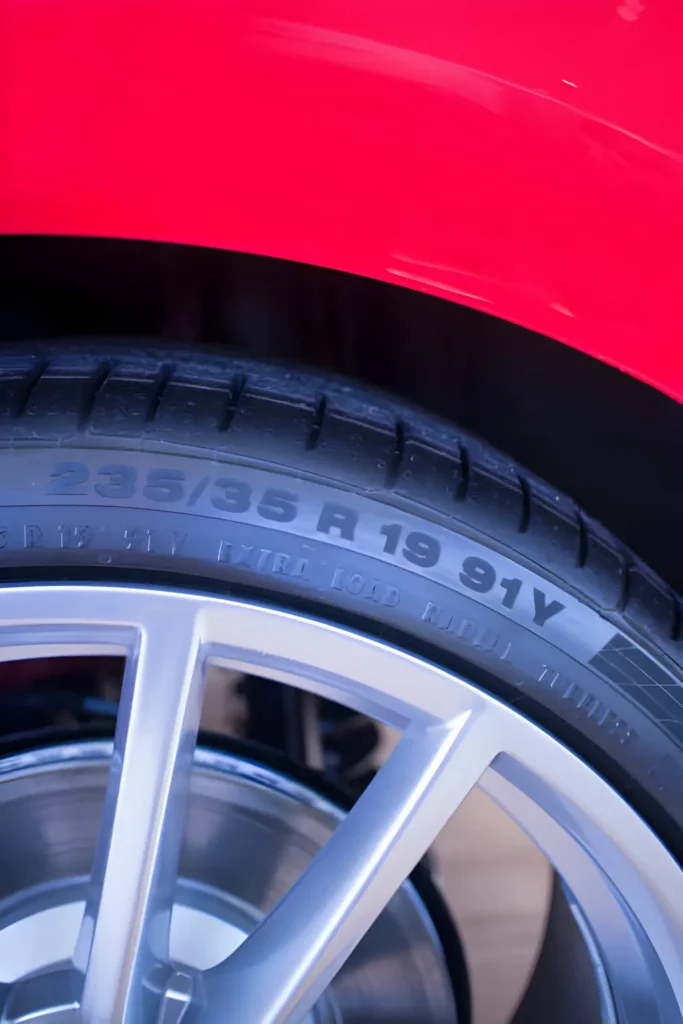
The easiest place to start is the sidewall of the tyre.
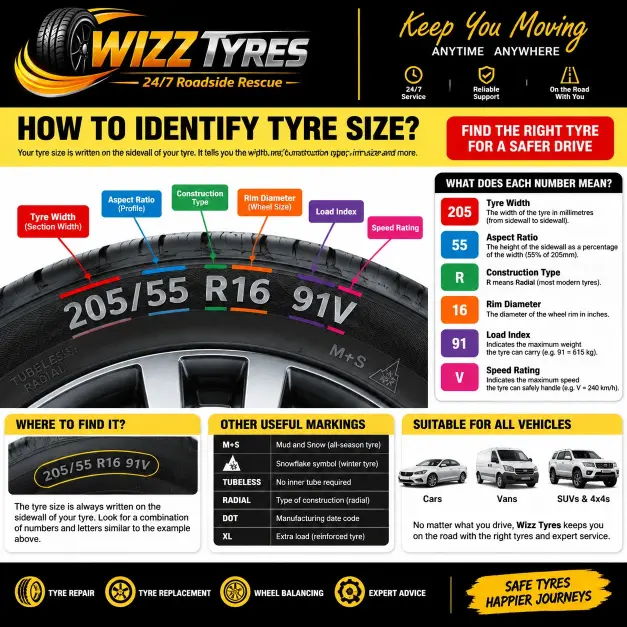
Look around the outer side of the tyre for a sequence containing numbers and letters. A common example is:
205/55 R16 91V
The exact combination will vary according to your vehicle and the tyre fitted.
TyreSafe explains that the sidewall carries several pieces of information, including the tyre dimensions, service description, manufacturer details and other identification markings.
What should you look for?
You are looking for the part that resembles: 205/55 R16 –
You may then see another number and letter immediately afterwards: 91V
Together, these markings tell you considerably more than the physical width of the tyre.
What if I cannot see the complete marking?
Do not assume that the tyre has no size information.
Part of the marking may simply be hidden from your view because of the position of the wheel. If it is safe to do so, inspect the accessible section of the sidewall carefully.
However, do not put yourself at risk to read a tyre, particularly if your vehicle is stopped on a busy road, hard shoulder or motorway.
If you are dealing with a roadside problem, safety should come before identifying a number printed on the tyre.
How to Read the Numbers on Your Tyre
Let’s use this example: 205/55 R16 91V
Each part has a specific purpose.
| Marking | What it tells you |
| 205 | Nominal tyre width in millimetres |
| 55 | Aspect ratio |
| R | Radial construction |
| 16 | Rim diameter in inches |
| 91 | Load index |
| V | Speed symbol |
The first four characters describe the physical tyre dimensions and construction. The final number and letter describe its load and speed capability.
Let’s look at each one separately.
What Does 205 Mean on a Tyre?
The first number represents the tyre’s nominal section width, expressed in millimetres.
So, in: 205/55 R16
the 205 relates to a nominal width of 205 mm.
It is important not to interpret this as a measurement that you should take with a tape measure and use to choose another tyre.
Tyre dimensions are specified according to established tyre standards and manufacturer specifications. The number is there to identify the tyre specification.
Why does tyre width matter?
Width affects how the tyre interfaces with the road and forms part of the vehicle’s approved wheel-and-tyre combination.
Changing from the manufacturer’s specified size can affect factors such as:
- clearance around the wheel
- steering behaviour
- handling
- ride characteristics
- speedometer performance
- load capability
- compatibility with the wheel
For that reason, choosing a replacement should involve more than simply finding something that appears physically similar.
What Does 55 Mean on a Tyre?
The second number is the aspect ratio.
In: 205/55 R16
the number 55 means that the sidewall height is approximately 55% of the nominal tyre width.
Using the example: 205 × 55% = approximately 112.75 mm
That calculation helps illustrate the relationship between width and sidewall height.
It does not mean that every physical measurement of the tyre will correspond exactly to that figure.
Why is aspect ratio important?
A change in profile can alter the overall characteristics of the wheel and tyre assembly.
For example, moving to a lower-profile tyre may change the vehicle’s appearance and handling response, but it is not automatically an appropriate upgrade.
If you are considering a different size, check the vehicle manufacturer’s approved specifications or ask a qualified tyre professional rather than making the decision based solely on appearance.
What Does R Mean on a Tyre?
The R indicates radial construction.
Radial construction is the standard type used across most modern passenger-car tyres.
You may therefore see: 205/55 R16
The R sits between the aspect ratio and wheel diameter.
It is not a reference to the tyre’s speed rating.
That distinction matters because drivers sometimes see letters in the sidewall marking and assume every letter represents speed.
It does not.
What Does 16 Mean on a Tyre?
The 16 identifies the nominal diameter of the wheel rim that the tyre is designed to fit.
In: 205/55 R16
the tyre is intended for a 16-inch rim.
This is why tyre size and wheel size are closely connected.
A tyre designed for a 16-inch rim cannot simply be treated as interchangeable with one designed for a 17-inch rim because the numbers look similar.
The tyre and wheel need to form an approved and compatible combination for the vehicle.
What Does 91V Mean?
This is where tyre identification becomes more than simply understanding physical dimensions.
In: 205/55 R16 91V
the 91 is the load index and the V is the speed symbol.
They are sometimes referred to together as the tyre’s service description.
TyreSafe identifies the load index and speed symbol as important parts of the information shown on the tyre sidewall.
What Does 91 Mean on a Tyre?
The number 91 represents a load index.
A load index is not itself a weight measurement. It is a standardised code corresponding to a maximum load capacity for the tyre.
For example, the recognised load-index table shows that index 91 corresponds to 615 kg for a single tyre.
However, this does not mean you should simply choose any tyre marked 91 because the number seems sufficient.
The vehicle manufacturer’s requirements still matter.
The tyres fitted to a vehicle must have an appropriate load capability for the vehicle and its intended use. GOV.UK guidance explains that tyre load ratings need to be suitable for the relevant axle loading.
Why is load index important?
Imagine loading your car for a long journey.
You may have:
- several passengers
- luggage
- shopping
- equipment
- additional cargo
The tyres carry the vehicle and its load.
That is why load capacity is a safety specification, not simply another number printed on the sidewall.
What Does V Mean on a Tyre?
The V is the tyre’s speed symbol.
It indicates the maximum approved speed capability associated with that tyre’s specified load conditions.
For example, TyreSafe’s current speed-rating table lists V as 149 mph / 240 km/h.
But there is an important point here:
A tyre’s speed rating is not a recommendation to drive at that speed.
UK road speed limits remain applicable regardless of the tyre’s capability.
The rating is part of the tyre’s engineering specification and helps indicate whether the tyre is suitable for the vehicle’s requirements.
TyreSafe notes that speed ratings affect safety and vehicle performance and should be appropriate for the vehicle.
Does My Car Need Exactly This Tyre Size?
This is one of the most important questions to understand.
Do not choose a replacement solely because the tyre fits the wheel.
The correct specification depends on the vehicle manufacturer’s approved requirements.
Two tyres can have the same wheel diameter but differ in:
- width
- aspect ratio
- load index
- speed rating
- construction
- application
A tyre professional therefore looks beyond one number.
What should you check?
Before purchasing a replacement, compare the information with:
- The vehicle manufacturer’s recommended specification
- The vehicle handbook
- The manufacturer’s tyre information
- The information displayed on the vehicle where applicable
- The specification of the tyres currently fitted
If you are uncertain, ask a qualified tyre specialist to confirm the correct fitment.
TyreSafe recommends that replacement tyres have the appropriate speed capability and load index for the vehicle, while its guidance also stresses matching tyre and rim sizes according to manufacturer recommendations.
Where Else Can I Check My Vehicle’s Tyre Specification?
The tyre sidewall is usually the quickest place to identify the current size, but it is not your only source.
Vehicle handbook
Your handbook can provide important information about your vehicle’s recommended tyre specifications and pressures.
Manufacturer information
Some vehicles provide tyre information on a label or plate fitted to the vehicle.
Depending on the model, this may be located around areas such as:
- driver’s door frame
- door pillar
- fuel-filler area
- another manufacturer-designated position
Existing tyres
The current tyre sidewall can help identify what is fitted.
But there is an important caution:
Do not automatically assume that the existing tyre is the manufacturer’s recommended specification.
A previous owner may have changed the wheels or tyres.
That is why comparing the current marking with the vehicle manufacturer’s information is sensible when there is any doubt.
Can I Rely on the Size Printed on My Current Tyre?
It can be useful, but it should not be your only reference if you are unsure.
For example, imagine buying a second-hand car.
The previous owner may have:
- changed the wheels
- fitted aftermarket wheels
- selected a different approved option
- installed a tyre that does not match the original specification
If you simply copy the current sidewall marking without checking the vehicle’s approved requirements, you could repeat an unsuitable fitment.
The better approach
Use the sidewall marking as a starting point.
Then verify it against the vehicle manufacturer’s recommended specification.
This is particularly important if:
- the wheels are not original
- the vehicle has been modified
- the tyre size looks unusual
- different sizes appear on the front and rear
- you are replacing more than one tyre
- you are unsure about the load or speed rating
What If I Cannot Read My Tyre Size?
There are several reasons why the marking may be difficult to identify.
The sidewall could be:
- dirty
- worn
- damaged
- partly hidden
- positioned awkwardly
- difficult to access because of the vehicle’s location
If the tyre is dirty, carefully cleaning the visible sidewall may make the markings easier to read.
But do not put yourself in danger to inspect a tyre.
What if the tyre is badly damaged?
If you have a puncture, sidewall damage or another serious tyre problem, avoid driving unnecessarily just to search for the number.
GOV.UK advises drivers that vehicles must remain safe to drive and that tyres should have the correct tread and be free from cuts and defects.
If you are stranded somewhere unsafe, provide your vehicle details and location to a suitable tyre or roadside professional.
They can help determine the appropriate replacement or advise on the safest next step.
Tyre Size vs Tyre Pressure: What’s the Difference?
These two pieces of information are often confused.
They are completely different.
Tyre size
Something like: 205/55 R16 91V
describes the tyre’s dimensions, construction, load index and speed capability.
Tyre pressure
Something such as: 2.3 bar
or its equivalent pressure in another unit refers to how much air should be inside the tyre.
The correct pressure depends on the vehicle, load and manufacturer’s specification.
GOV.UK states that tyres should be inflated according to the vehicle manufacturer’s specification for the load being carried.
Why shouldn’t I copy the pressure from another car?
Because tyre pressure is vehicle-specific.
Even two cars using tyres with similar dimensions may have different recommended pressures.
Always check the vehicle handbook or the manufacturer’s pressure information.
What Else Should I Check Before Replacing a Tyre?
Knowing the correct size is only one part of tyre maintenance.
Before arranging a replacement, look at the overall condition of the tyre where it is safe to do so.
Check for visible damage
Look for:
- cuts
- cracks
- bulges
- punctures
- exposed cords
- unusual deformation
- significant sidewall damage
A damaged tyre can require professional inspection even if the tread appears reasonable.
Check tread depth
For cars, light vans and light trailers in Great Britain, the legal minimum tread depth is 1.6 mm across the central three-quarters of the tread and around the complete circumference.
However, waiting until the tyre reaches the legal limit is not the same as maintaining tyres in good condition.
Regular inspection gives you an opportunity to identify deterioration before it becomes a more serious problem.
Look for uneven wear
If one part of the tread appears significantly more worn than another, do not simply replace the tyre and forget about the cause.
Uneven wear can be associated with issues involving:
- wheel alignment
- inflation
- suspension
- steering components
- tyre condition
A professional inspection can help determine whether the tyre is the symptom of another problem.
Why Does Tyre Size Matter When Buying a Replacement?
Choosing the correct tyre is about compatibility, not just appearance.
The right specification helps ensure that the tyre works appropriately with the vehicle’s:
- wheel
- load requirements
- speed capability
- steering system
- suspension
- braking characteristics
- electronic systems where relevant
A tyre that physically fits the wheel is not automatically the correct choice for the vehicle.
This is why a professional tyre fitter checks the complete specification instead of looking at only the first three numbers.
What Information Should I Give a Mobile Tyre Fitter?
If you need a replacement tyre, giving accurate information at the beginning can make the process much easier.
Where possible, provide:
1. Vehicle registration
This can help identify the vehicle.
2. Make and model
For example, Ford, BMW, Volkswagen, Mercedes-Benz or another manufacturer.
3. Tyre marking
If you can safely read it, provide the complete code rather than only the first part.
For example: 205/55 R16 91V
is more useful than simply saying:
“I need a 16-inch tyre.”
4. Which tyre is affected?
Tell the fitter whether the problem is at:
- front left
- front right
- rear left
- rear right
5. What happened?
Explain whether you have:
- a puncture
- a damaged sidewall
- a worn tyre
- a flat tyre
- a suspected blowout
- another issue
6. Your location
If you require mobile assistance, provide an accurate location and explain whether you are:
- at home
- at work
- parked somewhere
- on a roadside
- near a motorway
- in another potentially hazardous position
The more useful information you provide, the easier it is for the tyre professional to understand the situation before travelling to you.
What If I Am Stranded With a Damaged Tyre?
If your vehicle becomes disabled because of a puncture or damaged tyre, your first priority should be personal safety.
Do not stand in a dangerous position beside fast-moving traffic simply to photograph a tyre marking.
If you are on or near a motorway or another high-speed road, follow the appropriate roadside safety guidance and seek assistance.
If it is safe to do so, you can provide the tyre professional with:
- registration number
- vehicle model
- tyre information
- location
- description of the problem
- photographs where safe and practical
If you cannot identify the tyre specification, do not guess.
A professional can help establish what is required.
Can I Put a Different Tyre Size on My Car?
Sometimes vehicles have more than one approved tyre specification, but that does not mean every alternative size is suitable.
A different size may affect:
- rolling circumference
- clearance
- steering
- handling
- load capability
- speedometer readings
- wheel compatibility
If you are considering changing size, check the vehicle manufacturer’s approved options or obtain professional advice before purchasing.
Do not choose a different size simply because it is cheaper, wider, narrower or visually appealing.
Should All Four Tyres Be the Same Size?
That depends on the vehicle.
Some cars use the same specification at all four corners.
Others may use different approved sizes between the front and rear axles.
This is sometimes known as a staggered setup.
Therefore, never assume that the tyre specification on one axle automatically applies to every wheel.
Check the vehicle manufacturer’s requirements.
If you are replacing tyres and notice different sizes at the front and rear, tell the tyre professional.
What Does XL Mean on a Tyre?
You may also notice additional markings alongside the main size code.
One example is XL, commonly used to indicate an Extra Load tyre.
TyreSafe explains that “Extra Load” denotes a higher load capacity than a standard tyre, while “Reinforced” can be used as an alternative marking.
This is another reason why copying only the basic width/profile/wheel-size section may not give you the complete specification.
If the vehicle requires a particular load construction, that requirement should be considered when selecting the replacement.
What Do Directional and Asymmetric Tyre Markings Mean?
Not every marking on the sidewall relates to size.
Some tyres have specific fitting requirements.
Directional tyres
A directional tyre may have an arrow indicating the intended direction of rotation.
Asymmetric tyres
An asymmetric tyre can have markings such as:
OUTSIDE
which indicate the correct orientation of the tyre on the wheel.
These markings matter during fitting.
GOV.UK’s MOT guidance recognises markings indicating directional or asymmetric fitment.
So if you are checking your tyre before replacement, don’t focus exclusively on the size code.
Look at the surrounding markings too.
Does the Tyre Label Tell Me the Size?
If you are buying a new tyre, you may also encounter the EU/UK tyre label.
The label provides information intended to help consumers compare characteristics such as:
- fuel efficiency
- wet grip
- external noise
GOV.UK explains that tyres sold on the UK market carry information covering these performance characteristics, subject to the applicable rules and exemptions.
However, the tyre label is not a replacement for checking the correct vehicle fitment.
A tyre can have attractive performance ratings and still be unsuitable if it does not match the vehicle’s required size, load or speed specification.
A Simple Example: Reading 205/55 R16 91V
Let’s put everything together.
Suppose your tyre says:
205/55 R16 91V
You can read it as: 205
Nominal section width in millimetres.55
Aspect ratio, expressed as a percentage of the tyre width.
R – Radial construction.
16- Nominal rim diameter in inches.
91- Load index.
V- Speed symbol.
That is the basic information.
But a professional tyre check does not end there.
You should still consider whether that complete specification is appropriate for your particular vehicle.
Five Common Mistakes Drivers Make When Identifying Tyres
1. Looking only at the wheel diameter
A driver may say: “I have 17-inch wheels, so I need a 17-inch tyre.”
That is incomplete.
Wheel diameter is only one part of the specification.
2. Ignoring the load index
Two tyres can share the same physical size but have different load capabilities.
The number after the main size code matters.
3. Treating the speed rating as optional
The letter at the end also forms part of the specification.
Do not assume that any letter will do.
4. Copying the current tyre without checking
An existing tyre is useful evidence, but previous modifications or incorrect fitment can make it unreliable as your only source.
5. Guessing during a roadside emergency
If you cannot safely identify the marking, don’t put yourself in danger.
Provide your vehicle details and location to a professional instead.
Quick Tyre Size Checklist
Before ordering a replacement, ask yourself:
Have I identified the complete sidewall marking?
Have I checked the vehicle manufacturer’s recommended specification?
Have I confirmed the load index?
Have I checked the speed symbol?
Have I considered whether the front and rear specifications differ?
Have I inspected the tyre for visible damage?
Do I know the recommended pressure for my vehicle?
If the tyre is damaged, am I in a safe place?
If you cannot answer these confidently, professional advice can prevent an expensive or potentially unsafe guess.
Frequently Asked Questions About Tyre Size
Where can I find my car’s tyre size?
Look on the tyre sidewall for a sequence containing numbers and letters, such as 205/55 R16 91V. You can also check the vehicle handbook and manufacturer’s information.
What does 205/55 R16 mean?
It identifies the tyre’s nominal width, aspect ratio, construction type and rim diameter. In this example, 205 relates to width, 55 to aspect ratio, R to radial construction and 16 to the rim diameter.
What does 91V mean?
The 91 is the tyre’s load index, while V is its speed symbol. Both form part of the tyre’s service description and should be appropriate for the vehicle.
Does 91 mean the tyre carries 91 kg?
No. The number is a load-index code rather than a kilogram measurement. For example, index 91 corresponds to 615 kg for a single tyre under the relevant rating system.
Does V mean I can drive at 149 mph?
No. V corresponds to a rated maximum speed capability of 149 mph / 240 km/h under the applicable test conditions and load rating. It does not override UK road speed limits.
Can I put any tyre with the same diameter on my car?
No. Rim diameter is only one element. Width, aspect ratio, load index, speed rating, construction and vehicle compatibility all need consideration.
Can I use a different tyre size?
Only if the alternative is an approved and suitable specification for your vehicle. Check manufacturer information or consult a tyre professional before changing size.
Can I identify my tyre size from my registration number?
A registration number can help a tyre professional identify the vehicle, but it should not be treated as a substitute for checking the actual vehicle and tyre specification. If the current tyres, wheels or vehicle have been modified, additional verification may be necessary.
Is tyre size the same as tyre pressure?
No. Tyre size identifies the physical and performance specification of the tyre. Pressure describes how much air should be inside it. Follow the vehicle manufacturer’s recommended pressure.
Where can I find the correct tyre pressure?
Check the vehicle handbook or the manufacturer’s tyre-pressure information. GOV.UK states that tyres should be correctly inflated according to the manufacturer’s specification for the load being carried.
What should I do if the numbers on my tyre are unreadable?
Check the vehicle handbook and manufacturer information. If you are stranded or the tyre is damaged, do not put yourself in an unsafe position simply to read the sidewall. Ask a tyre professional for assistance.
Should all four tyres have identical markings?
Not necessarily. Some vehicles use the same specification on every wheel, while others have approved differences between front and rear axles. Always follow the vehicle manufacturer’s requirements.
What does XL mean on a tyre?
XL generally indicates an Extra Load tyre, meaning it has a higher load capability than the standard version of the same basic size.
What should I tell a mobile tyre fitter?
Give the vehicle registration, make and model, your location, the affected wheel, the problem you are experiencing and the complete tyre marking if you can safely read it.
Can I drive with a punctured tyre to a tyre shop?
Do not assume that it is safe. A punctured or seriously under-inflated tyre can suffer internal damage, and driving on it may make the situation worse. If you are unsure, obtain professional assistance rather than taking unnecessary risks.
How do I know if a tyre needs replacing?
Look for serious damage, excessive or uneven wear, insufficient tread and other visible defects. Cars, light vans and light trailers in Great Britain require at least 1.6 mm of tread across the central three-quarters and around the entire circumference.
Need Help Identifying or Replacing a Tyre?
Understanding the marking on your tyre is a useful first step, but choosing the correct replacement involves more than matching a few numbers.
If you have a puncture, damaged tyre or worn tyre and are unsure which specification you need, a professional tyre fitter can check the vehicle, confirm the appropriate requirement and advise you on the available options.
Wizz Tyres provides mobile tyre assistance, including tyre replacement and emergency mobile tyre fitting, allowing customers to receive help at a suitable location rather than necessarily travelling to a traditional tyre centre.
If you are contacting Wizz Tyres for assistance, having your vehicle registration, location and tyre information available can help the team understand your situation more quickly.
And if you cannot safely read the tyre marking because you are stranded somewhere dangerous, don’t worry about guessing.
Your safety comes first.
Final Takeaway
The next time you see: 205/55 R16 91V
you should know that it is not just a random collection of numbers and letters.
It tells you:
- the tyre’s nominal width
- its profile
- its construction
- the wheel diameter it is designed for
- its load index
- its speed symbol
But identifying the marking is only half the job.
Before buying a replacement, make sure the complete specification is suitable for your vehicle. Check the manufacturer’s information, consider the tyre’s condition and seek professional advice whenever something does not look right.
A few minutes spent checking the specification can prevent the much bigger problem of fitting the wrong tyre.