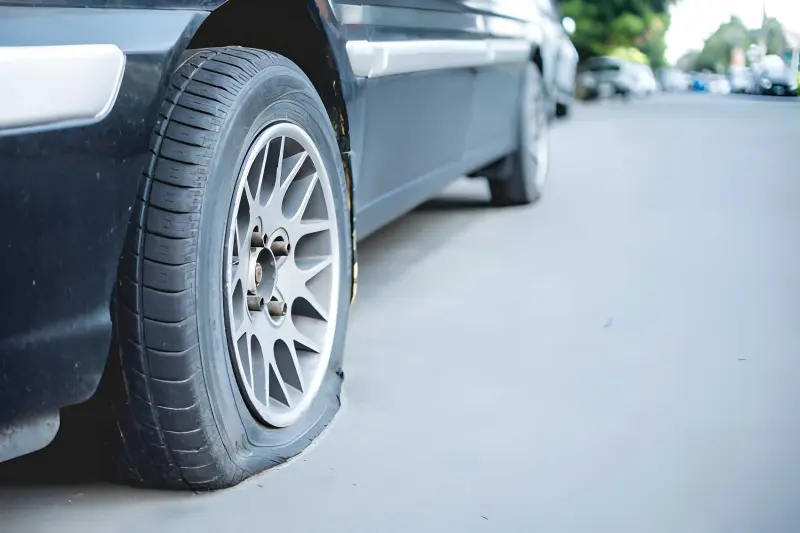
A flat tyre on the motorway is one of those moments where panic can take over fast. The short answer: don’t brake sharply, don’t try to change lanes suddenly — instead, ease off the accelerator, keep the wheel steady, and aim for the hard shoulder or nearest exit, indicating early so other drivers see you coming. Once you’re safely off the live carriageway, get yourself and any passengers behind the barrier, and call for help rather than attempting a roadside change on a motorway edge.
We’ve spent years recovering drivers from hard shoulders across Birmingham, Warwickshire, Staffordshire and Worcestershire, and the pattern is always the same — the drivers who stay calm and follow a clear sequence of steps come away from it fine. The ones who panic, swerve, or try to fix things themselves in live traffic are the ones who end up in genuinely dangerous situations. This guide walks through exactly what to do, in order, so you’re not making decisions under pressure.

Why a Motorway Flat Tyre Is Different From a Normal One
A flat tyre in a car park or on a quiet side road is an inconvenience. A flat tyre at 70mph on a live carriageway is a safety event. The difference comes down to three things:
- Speed — a sudden loss of pressure at motorway speed can pull the car toward the affected side, and overcorrecting is what causes most tyre-related motorway incidents, not the puncture itself.
- Traffic density — motorways like the M6, M5, M40 and M42 carry a constant stream of vehicles at speed, which shrinks your window for making a safe manoeuvre.
- Limited stopping space — unlike a residential street, you often can’t just pull over wherever you like. You need to reach a hard shoulder, emergency refuge area, or exit slip road.
Understanding this distinction is the reason the steps below focus so heavily on how you get off the road, not just that you need to.
Step-by-Step: What To Do the Moment You Feel a Flat
If you feel the car pulling, hear a flapping or thudding sound, or see a tyre pressure warning light, follow this sequence:
- Grip the wheel firmly and don’t brake hard. Sudden braking on a losing tyre can cause loss of control. Ease off the accelerator instead and let the car slow naturally.
- Check your mirrors and indicate early. Give other drivers as much notice as possible that you’re moving across lanes.
- Move gradually toward the left-hand lane and hard shoulder. Avoid sharp steering inputs — small, steady corrections only.
- Pull as far onto the hard shoulder or refuge area as possible. Get the car close to the barrier, with wheels angled away from the carriageway if it’s on a slope.
- Put your hazard lights on immediately once you’re stationary, and keep sidelights on if visibility is poor.
- Exit the vehicle from the passenger side, away from live traffic, and get everyone behind the safety barrier.
- Call for help — either the motorway’s emergency phone (orange SOS phones are spaced roughly every 1.5km along most UK motorways) or a mobile tyre assistance service.
If you’re on a smart motorway with no hard shoulder and can’t reach a refuge area, stay in the car with your seatbelt on, hazards on, and call 999 immediately — this is one of the few situations where staying inside the vehicle is the safer option.
If You Can’t Reach the Hard Shoulder
Sometimes a tyre fails in a live lane before you can move across — this is rare but it happens, particularly with sudden blowouts. In this case:
- Keep hazards on straight away.
- Slow down as gradually as possible without slamming the brakes.
- Signal and move across lanes only when there’s a genuine gap, not just because you feel you need to rush.
- If you’re truly stuck in a live lane and can’t move at all, stay belted in, keep hazards on, and call 999 — motorway control rooms can close lanes remotely on smart motorways to protect you.
Common Mistakes We See Drivers Make
After years of mobile call-outs across the Midlands, a few mistakes come up again and again:
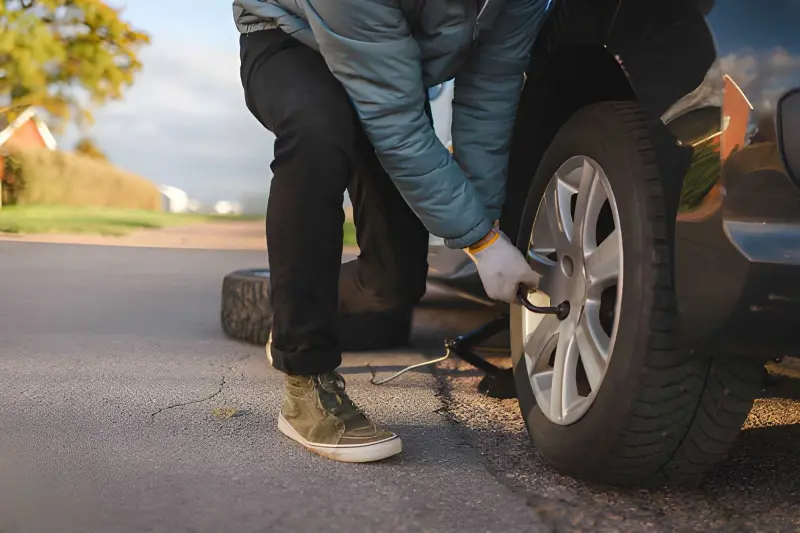
- Trying to change the tyre themselves on the hard shoulder. The hard shoulder is not a safe place to be outside your vehicle — vehicles pass within a few feet at speed, and every year people are seriously hurt or killed changing tyres in this exact spot. Leave it to a professional or wait for recovery.
- Standing on the traffic side of the car. Even when parked correctly, get out and stand on the verge side, behind the barrier if there is one.
- Underestimating a slow puncture. A tyre that “feels a bit soft” can deteriorate into a full blowout within a few miles at motorway speed, particularly in hot weather when tyre pressures build faster.
- Not carrying a working spare or repair kit. Many newer vehicles come with a space-saver spare or a sealant kit only — knowing which one your car has, before you need it, saves confusion in the moment.
- Continuing to drive on a flat “just to reach the next exit.” This can destroy the tyre, the wheel rim, and sometimes the suspension, turning a simple tyre replacement into a much bigger repair bill.
Local Driving Conditions Worth Knowing
Anyone who drives regularly across Birmingham, Warwickshire and Worcestershire will know the motorway network here is busy and varied — the M6, M42, M40, M5 and the A45/A46 dual carriageways all carry heavy commuter and freight traffic. A few local factors that make tyre failures more likely or more hazardous:
- Sections of the M6 through Birmingham run as smart motorway with no permanent hard shoulder, meaning emergency refuge areas are your main stopping option.
- Rural stretches around Warwickshire, near towns like Warwick, Leamington Spa, Rugby and Stratford-upon-Avon, mix motorway and fast A-road driving, where verges are narrower and less lit at night.
- Worcestershire’s motorway approaches, including the M5 corridor near Worcester and Droitwich, see frequent surface spray and standing water in wet weather, which increases the chance of hydroplaning on a tyre that’s already low on tread.
- Pothole damage on slip roads and roundabouts feeding into the motorway network is a common, often overlooked cause of sidewall punctures.
Cost of a Flat Tyre Callout on the Motorway
Costs vary depending on the tyre size, whether it’s a repair or full replacement, and the time of day, but as a general guide:
| Situation | Typical Cost Range |
| Mobile puncture repair (repairable damage) | Lower end of the scale — often the cheapest fix |
| Mobile tyre replacement (single tyre, standard size) | Mid-range — depends on tyre brand and size |
| Emergency out-of-hours or motorway-side callout | Slightly higher than a home or workplace visit due to access and safety requirements |
| Locking wheel nut removal (if key is missing) | Added on top of the tyre cost |
Exact pricing depends on your vehicle and tyre size, so it’s always worth getting a quick quote over the phone before a technician is dispatched — a reputable mobile fitter will never hide pricing until they arrive.
Prevention: Reducing Your Risk Before You Ever Reach the Motorway
Most motorway tyre failures are preventable with a few minutes of routine checking:
- Check tyre pressure monthly, including the spare, and always before a long motorway journey.
- Check tread depth — the legal minimum in the UK is 1.6mm, but performance and safety drop off noticeably before you hit that limit, especially in wet conditions.
- Look for sidewall bulges or cracking, which often signal an impact fracture that can fail suddenly under motorway speed and heat.
- Rotate tyres regularly if your vehicle and tyre type call for it, to even out wear.
- Avoid mixing old and new tyres on the same axle where possible, as uneven grip levels can affect handling.
- Get any slow puncture looked at immediately rather than “topping up” the pressure and hoping it holds.
A five-minute pre-drive check, particularly before a longer trip on the M6, M5 or M42, catches the majority of issues before they become a roadside emergency.
When to Call a Professional in Birmingham, Warwickshire or Worcestershire
Some situations genuinely need a trained technician rather than a DIY fix, including:
- Any puncture that happens on a live motorway lane or hard shoulder — safety alone rules out a self-repair here.
- Sidewall damage, which generally cannot be safely repaired and needs a replacement.
- Locking wheel nuts with a missing or damaged key.
- Repeated pressure loss with no obvious visible cause.
- Any situation where you’re not confident jacking the vehicle safely on a slope or uneven verge.
In these cases, a mobile tyre fitting service can come directly to your location — hard shoulder, refuge area, or wherever you’ve managed to safely stop — and get you back on the road without you needing to move the vehicle yourself.
Why Choose Us for Mobile Tyre Fitting in Birmingham, Warwickshire and Worcestershire
We built our service around exactly this kind of situation — a driver stuck at the roadside, needing help fast and safely.
- Genuinely local coverage across Birmingham, Warwickshire, Worcestershire and the surrounding Midlands counties, so we’re rarely far from wherever you’ve broken down.
- Fast typical response times, usually arriving within 10–30 minutes depending on location and traffic.
- Certified, insured technicians who are trained to work safely at the roadside, not just in a driveway.
- Transparent pricing before dispatch — no surprise call-out fees once the job is done.
- 24/7 availability, because motorway breakdowns don’t stick to office hours.
If you’re stuck on the hard shoulder right now or planning ahead for future peace of mind, our mobile tyre fitting team is built for exactly this kind of call-out.
Get emergency mobile tyre fitting now →
Local Coverage: Nearby Areas We Reach Quickly
Beyond the main city centres, our mobile technicians regularly attend breakdowns in the surrounding towns and suburbs, including:
- Around Birmingham: Solihull, Sutton Coldfield, West Bromwich, Dudley, Halesowen, Smethwick, Erdington
- Around Warwickshire: Warwick, Leamington Spa, Rugby, Stratford-upon-Avon, Nuneaton, Kenilworth
- Around Worcestershire: Worcester, Redditch, Kidderminster, Droitwich Spa, Bromsgrove, Evesham
If you’ve broken down on a motorway slip road or A-road feeding into any of these areas, help is typically not far away.
Frequently Asked Questions
Is it safe to change a tyre on the motorway hard shoulder myself? No — it’s not recommended, as standing outside your vehicle on the hard shoulder puts you at serious risk from passing traffic.
What should I do first if I get a flat tyre on the motorway? Ease off the accelerator without braking hard, indicate early, and move gradually to the hard shoulder or nearest refuge area.
Can I drive slowly on a flat tyre to reach the next exit? Driving even a short distance on a flat can damage the wheel rim and suspension, so it’s best avoided unless there’s genuinely no safer option.
What if I break down on a smart motorway with no hard shoulder? Stay inside the vehicle with your seatbelt and hazards on, and call 999 immediately so the lane can be closed remotely.
How much does a mobile tyre replacement cost on the motorway? Pricing depends on tyre size and time of day, but a quote is normally given over the phone before a technician is sent out.
How quickly can a mobile tyre fitter reach me on the motorway? Typical response times in Birmingham, Warwickshire and Worcestershire are around 10–30 minutes depending on traffic and exact location.
Do I need to move my car if I have a flat tyre on the motorway? No — a mobile tyre fitting service can come directly to your location, including the hard shoulder or a refuge area, so you don’t need to move the vehicle yourself.