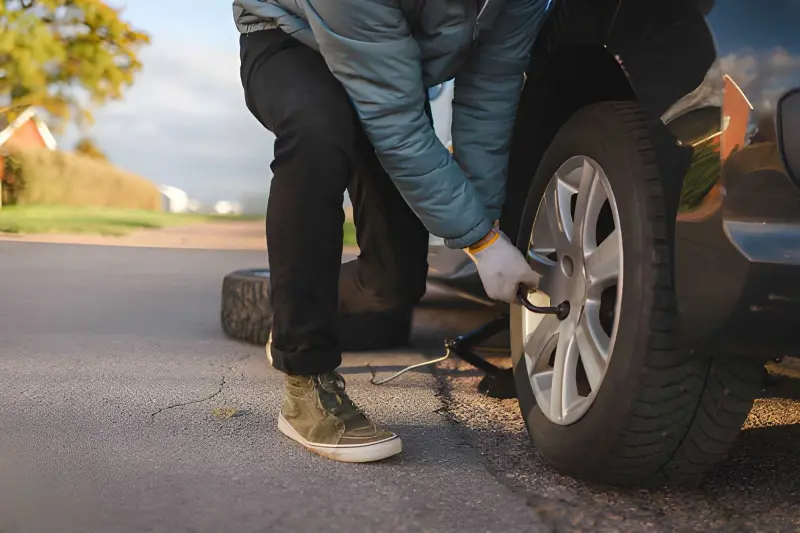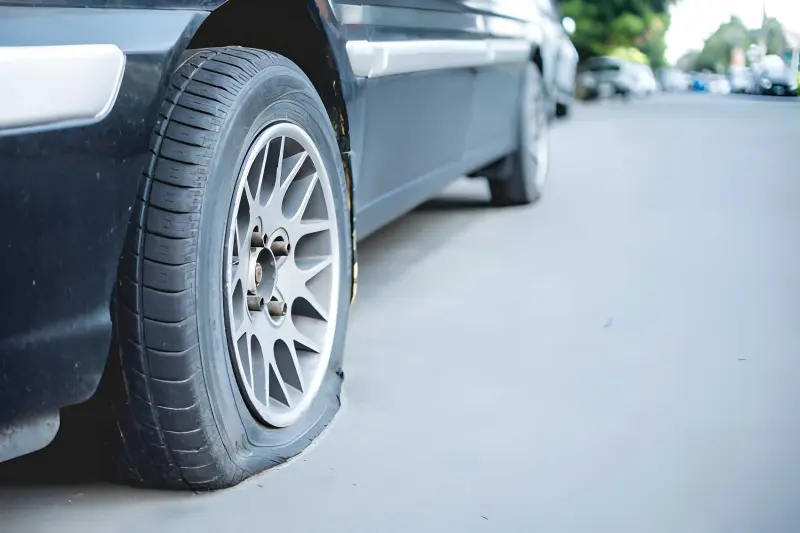
Short answer: Yes, you can usually drive a short distance with a slow puncture, but only carefully, at reduced speed, and only until you can get it checked or repaired — driving on it for days or weeks risks a blowout, wheel damage, and an MOT failure. A slow puncture rarely stops a car in its tracks the way a full blowout does, which is exactly what makes it dangerous. It quietly drains air over hours or days, and by the time most drivers notice, the tyre has already been running underinflated for far longer than is safe.
If you’ve searched this because your tyre pressure warning light keeps coming back on, or you’ve noticed your car pulling slightly to one side on the way to work in Birmingham or along the A46 near Warwick, this guide will walk you through exactly what’s safe, what isn’t, and what to do next.
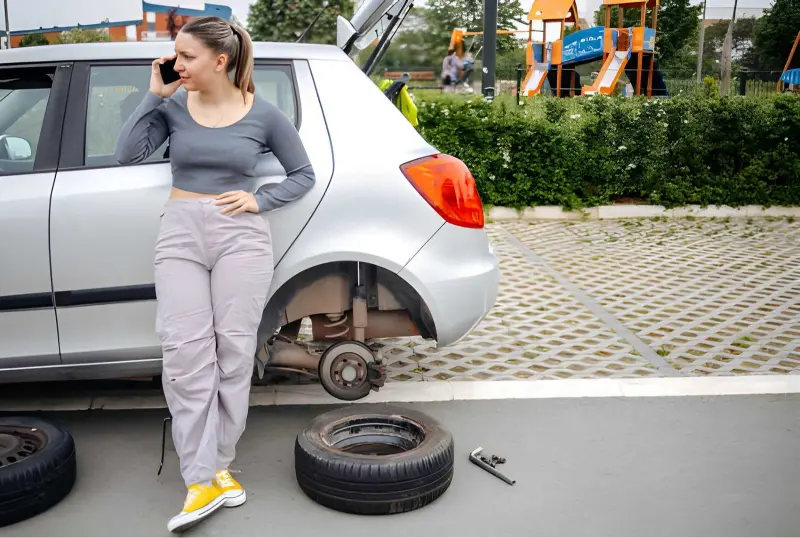
What Is a Slow Puncture?
A slow puncture is a small leak in a tyre — usually from a nail, screw, thorn, or a damaged valve — that lets air escape gradually rather than all at once. Unlike a blowout, which is sudden and obvious, a slow puncture might only lose 1–2 PSI a day, or sometimes over a week, depending on the size and location of the damage.
Common causes we see on call-outs across the Midlands include:
- A nail or screw picked up on a construction site or gravel driveway
- A slow leak around the valve stem, often from age or corrosion
- A hairline crack in the sidewall from kerbing a tyre
- A poor repair or worn seal on the wheel rim
- Porosity in an older, cracked tyre losing air through the rubber itself
Is It Safe to Drive With a Slow Puncture?
In short: it depends on how low the pressure has dropped and how far you need to go.
It’s generally considered acceptable to drive a short, careful distance — for example, to the nearest garage or a Wizz Tyres call-out point — if:
- The tyre still looks and feels close to its normal shape
- You’re driving under 20-30 mph, on quiet roads
- You’re not carrying a full load or towing
- The journey is under a few miles
It is not safe to continue driving if:
- The tyre is visibly bulging or squashed at the bottom
- You can hear a rhythmic thumping or flapping noise
- The steering feels heavy, vague, or is pulling hard to one side
- You’re planning motorway speeds or a long journey
A tyre running significantly underinflated generates far more heat through flex in the sidewall. On a warm day, or during a long stretch of the M6 or M42, that heat build-up is what turns a “slow” puncture into a sudden, dangerous blowout — often with no warning at all.
Slow Puncture Tyre Symptoms
Most drivers don’t spot a slow puncture from looking at the tyre — they notice it through how the car behaves. Watch for:
- Dashboard TPMS warning that clears after inflating but returns within a few days
- The car pulling gently to one side, especially under braking
- A change in road noise or a subtle vibration through the steering wheel
- Visibly lower tyre compared to the other three when parked on level ground
- Needing to top up air more than once every few weeks
A mistake we see constantly on jobs across Warwickshire and the Black Country: drivers top the tyre up with a foot pump and assume the problem is solved. If a tyre needed air twice in the same fortnight, it has a puncture — it isn’t “just losing pressure with the seasons.”
How Long Can You Drive With a Slow Puncture?
There’s no single safe mileage figure, because it depends entirely on how quickly the tyre is losing air and how low it’s already run. As a general guide:
| Situation | Recommended action |
| Tyre pressure only slightly low, warning just appeared | Drive cautiously to a garage or book a mobile repair within 24–48 hours |
| Pressure noticeably soft, warning light on for days | Get it checked same-day; avoid motorways |
| Tyre visibly low or squashed-looking | Do not drive — call for mobile assistance |
| Flat or near-flat | Do not drive at all, even a short distance |
As a rule of thumb we give clients over the phone: if you can still see a clear “shoulder” of tyre sidewall and the car drives normally at low speed, you likely have a short window to get somewhere safe. If the tyre is spreading out at the base, that window has already closed.
What To Do If It Happens While Driving
- Ease off the accelerator and avoid harsh braking or sudden steering
- Indicate early and move to the hard shoulder, a layby, or the nearest safe side road
- Turn on hazard lights once stationary
- Check the tyre — is it flat, bulging, or just soft?
- Call for mobile tyre assistance rather than attempting a motorway-side change yourself
- If you’re on a motorway shoulder, exit the vehicle from the passenger side and stand behind the barrier while you wait
This is the same guidance we give for a full flat tyre on the motorway — the safety priorities don’t change just because the puncture came on gradually rather than instantly.
Common Mistakes Drivers Make
- Driving on a warning light for weeks because the car “still feels fine”
- Topping up with a can of sealant as a permanent fix rather than a temporary one
- Ignoring a slow leak in winter, when cold weather naturally drops tyre pressure too, masking the real cause
- Continuing a long motorway journey because the nearest exit is “only a few more miles”
- Assuming all four tyres are fine just because only one warning light appeared
Cost of Slow Puncture Repair
Costs vary by tyre size, damage location, and whether the tyre can be safely repaired or needs replacing:
| Service | Typical Cost Guide* |
| Puncture repair (repairable zone, standard tyre) | Starts from £60 |
| Puncture repair, larger van/4×4 tyre | Starts from £80 |
| Valve replacement | Starts from £80 |
| Emergency call-out (mobile fitting) | Often included or a small additional fee depending on time/location |
| Full tyre replacement (if unrepairable) | Varies by brand and size |
*Prices are a general guide only — always confirm your exact quote before work begins. A tyre can usually only be repaired if the damage is within the central tread area and under a certain size; anything in the sidewall or shoulder typically needs replacing for safety reasons.
Prevention and Maintenance Tips
- Check tyre pressure monthly, ideally when tyres are cold
- Inspect tread and sidewalls visually every few weeks for embedded debris
- Don’t ignore a TPMS light — even a small, repeated warning is worth investigating
- Have valves checked at each tyre change, as they degrade with age
- Avoid kerbing tight corners around estates and multi-storey car parks, a common cause of slow sidewall leaks
- Rotate tyres regularly so wear — and puncture risk — is spread evenly
When to Call a Professional in Birmingham, Warwickshire and Worcestershire
Call a mobile tyre technician rather than attempting to drive to a garage if:
- The tyre is flat or visibly deflated
- You’re on a motorway hard shoulder or a fast, unlit road
- You don’t have a suitable spare or the tools to change one safely
- The puncture is in the sidewall, which cannot be repaired and needs an on-the-spot assessment
- You simply don’t have time to sit in a garage waiting room
A slow puncture that catches you out in a Birmingham city centre car park, on the outskirts of Leamington Spa, or on a rural lane near Stratford-upon-Avon doesn’t need to turn into a wasted afternoon. A mobile technician can come to your home, workplace, or roadside location and get you moving again without the detour to a fitting bay.
Why Choose Us for Puncture Repair in Birmingham and Warwickshire
- Fast response — typical arrival times of 10–30 minutes across our core coverage area
- We come to you — home, workplace, or roadside, day or night
- Honest assessment — we’ll tell you plainly if a tyre is repairable or needs replacing, not upsell unnecessarily
- Certified, insured technicians with years of hands-on experience across the Midlands
- No need to drive on a damaged tyre to reach us — we remove that risk entirely
GEO Coverage: Areas We Cover Near Birmingham, Warwickshire and Worcestershire
Beyond the main towns, our mobile technicians regularly attend slow puncture and tyre call-outs across the surrounding areas, including:
- Birmingham suburbs: Solihull, Sutton Coldfield, Erdington, Edgbaston, Kings Heath, Harborne
- Warwickshire towns: Warwick, Leamington Spa, Rugby, Stratford-upon-Avon, Nuneaton, Kenilworth
- Worcestershire towns: Worcester, Redditch, Bromsgrove, Kidderminster, Droitwich Spa
- Wider Midlands reach: Coventry, Solihull borough, and surrounding villages just off the M6, M42, and M5 corridors
Wherever a slow puncture catches you within these areas, a call-out is usually quicker than trying to nurse the car to a fixed garage.
Frequently Asked Questions
Q: Can you drive with a slow puncture?
Answer : Yes, for a short, careful distance at low speed, but it should be checked or repaired as soon as possible.
How long can you drive with a slow puncture?
Answer : There’s no fixed distance — it depends on how quickly the tyre is losing air, so treat any noticeable pressure loss as urgent.
Q: Is it safe to drive on the motorway with a slow puncture?
Answer : No, motorway speeds generate heat that can turn a slow puncture into a sudden blowout.
Q: What are the symptoms of a slow puncture?
Answer : A recurring TPMS warning, the car pulling to one side, a visibly lower tyre, or needing to top up air repeatedly.
Q: Can a slow puncture be repaired, or does the tyre need replacing?
Answer : Most punctures in the central tread area can be repaired; sidewall or shoulder damage usually requires replacement.
Q: How much does a slow puncture repair cost?
Answer : Typically Starts around £60 for a standard tyre, though this varies by size and damage location.
Q: Is there a slow puncture repair service near me in Birmingham or Warwickshire?
Answer : Yes, mobile technicians cover Birmingham, Warwickshire, and Worcestershire, including surrounding towns and suburbs, with call-outs usually arriving within 10–30 minutes.
Don’t risk driving on a damaged tyre. Book a fast, mobile puncture repair and get back on the road safely, wherever you are in Birmingham, Warwickshire, or Worcestershire.